Every lambing season comes down to the same crucial few hours. Get colostrum right in the first day of a lamb's life and you set up everything that follows; growth rate, health, and how many lambs you rear through to sale.
This is the starting point for Winning at Weaning, our webinar on lamb colostrum management and milk replacer feeding, now available to watch on demand. Across three sessions, sheep farmers and consultants hear from a University of Glasgow researcher specialising in colostrum management in ruminants, from the Lamlac team on milk replacer trial results, and from a working Cornish sheep farm putting the theory into practice.
Colostrum management and failure of passive transfer
Katie Denholm BVMS MVS(EPi) PhD FRCVS our University of Glasgow speaker opens with why colostrum matters so much in sheep. A ewe's placenta blocks large antibody molecules from reaching the lamb before birth, so every lamb is born with no immunity of its own and depends entirely on colostrum for it. When a lamb doesn't absorb enough antibody quickly enough, it develops what's known as failure of passive transfer, or FPT, and those lambs are more likely to get sick, more likely to die, and slower to grow than their flock mates.
The session works through the five Qs of colostrum management: quality (a minimum of 50 grams of IgG per litre, tested cheaply with a BRIX refractometer), quantity (at least 50ml per kg of bodyweight, split across three feeds in the first 18 hours) and the timing, hygiene and calm handling that determine how much of that antibody the lamb actually absorbs. There's also a look at recent Glasgow research on colostrum hygiene, including a farm case study where 80% of feeding equipment tested positive for bacterial contamination, which blocks antibody uptake even when colostrum quality itself is good.
Milk replacer trial results
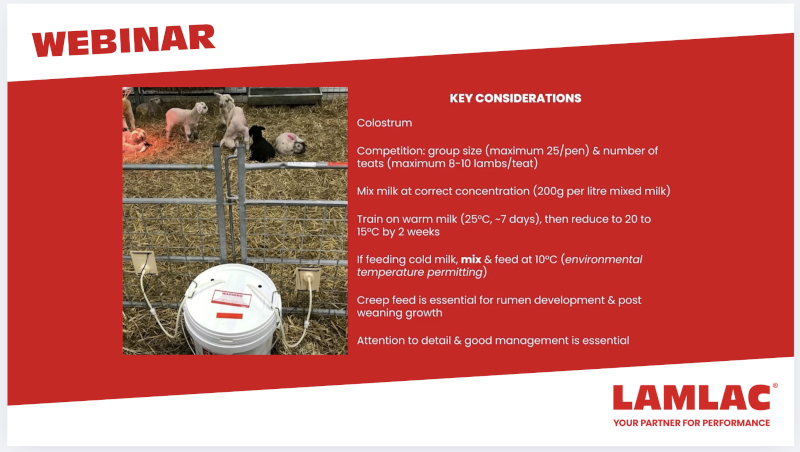
From there, the webinar moves on to feeding once colostrum is covered, with trial data from Harper Adams University and several commercial units comparing lambs reared on the ewe against those reared on Lamlac milk replacer from as early as 24 hours old. It covers how stepping the milk temperature down over the first weeks of life encourages lambs to eat more creep feed, so their rumen is properly developed by weaning, along with results from feeding milk cold rather than warm.
Case study - St Cattock Farm, Cornwall
The final session heads to St Cattock Farm on the north Cornwall coast, lambing around 350 ewes indoors each year. It follows the farm's approach to triplet lambs, from colostrum through to bottle feeding, equipment cleaning and abrupt weaning at around five weeks old.
What you'll learn
how failure of passive transfer affects lamb health, growth and flock productivity
the five Qs of colostrum management, including hygiene testing most flocks miss
Lamlac trial results comparing ewe-reared and milk replacer-reared lambs
how temperature stepping and creep feed intake affect weaning outcomes
a working farm's approach to feeding, hygiene and weaning triplet lambs
For more advice on feeding through to weaning, visit our Lambing advice page or get in touch with your Lamlac business manager.